
Remaining sharp and deeply focused during a busy workday feels harder than ever. Between Slack notifications, urgent email threads, background noise, and endless browser tabs, modern workers face a constant barrage of cognitive distractions.
Trying to force high concentration without a structured daily workflow quickly leads to exhaustion. Focus is not a finite muscle you flex through sheer willpower; it is the natural byproduct of a well-designed environment and consistent daily habits.
By building intentional daily routines to boost workplace focus, you can protect your attention span, eliminate afternoon energy slumps, and accomplish high-value work in fewer hours.
Quick Summary: The Ideal Focus Routine at a Glance
If you want a simple template to structure your workday for peak mental clarity, follow this three-phase routine:
-
Morning Phase (Preparation): Get natural light early, delay high-sugar breakfasts, and complete your most challenging task before opening email.
-
Midday Phase (Execution): Work in 45-minute distraction-free sprints, take a true screen-free lunch, and do physical resets.
-
Evening Phase (Recovery): Conduct a 5-minute workday shutdown, clear your desk, and transition out of work mode to protect your sleep.
The Science of Concentration: Why Routines Work
Every time you switch your attention from a deep report to a pinging chat notification, your brain incurs a cognitive penalty known as attention residue. Research from the American Psychological Association (APA) demonstrates that brief interruptions even those lasting only a few seconds can double error rates and take up to 20 minutes to fully recover original depth of focus.
Routines automate decision-making. When your morning, work blocks, and breaks follow a predictable structure, you eliminate decision fatigue. This preserves your prefrontal cortex’s executive energy for high-stakes problem-solving rather than deciding what to do next.
7 Daily Routines to Build Deep Workplace Focus
1. Anchor Your Circadian Rhythm in the Morning
Your ability to concentrate during office hours is heavily determined by what you do within ninety minutes of waking up. Exposure to early morning sunlight triggers a healthy release of cortisol, signaling to your brain that it is time for alertness.
-
Get 10 to 15 minutes of direct sunlight shortly after waking.
-
Delay heavy caffeine intake by 60 to 90 minutes to prevent a sharp afternoon crash.
-
Drink 16 ounces of water immediately to rehydrate your brain after hours of sleep.
Neuroscientists at Stanford Medicine highlight that viewing natural sunlight early in the day optimizes your circadian rhythm, which directly stabilizes cognitive focus and sleep quality.
2. Practice the “Eat That Frog” First-Hour Rule
The first ninety minutes of your workday represent your highest mental energy pool. Using this prime window to answer routine emails or browse news channels wastes your sharpest cognitive capacity on low-value chores.
Adopt the rule of finishing your single most important or challenging project your “frog” first thing in the morning:
-
Identify your priority task the evening before.
-
Sit down at your desk and open only the necessary workspace applications.
-
Do not open your email client or messaging apps until that single task is complete or worked on for at least 45 minutes.
Starting your morning with a tangible win builds momentum that carries throughout the rest of the day.
3. Work in Structured Time-Blocked Sprints
Sustained human attention naturally ebbs and flows in ultradian cycles. Attempting to sit still and maintain intense concentration for four continuous hours degrades output and increases mental slowness.
Structure your peak working hours using time-blocked focus sprints:
-
Sprint (45–50 Minutes): Set a visible timer, put your phone in another room or drawer, and execute a single task with complete intensity.
-
Recovery (10–15 Minutes): Step away from your computer screen, stretch, drink water, or look out a window to reset visual eye strain.
Working in rhythmic blocks conditions your brain to focus deeply, knowing that a dedicated rest window is right around the corner
4. Optimize Your Environment for Visual Simplicity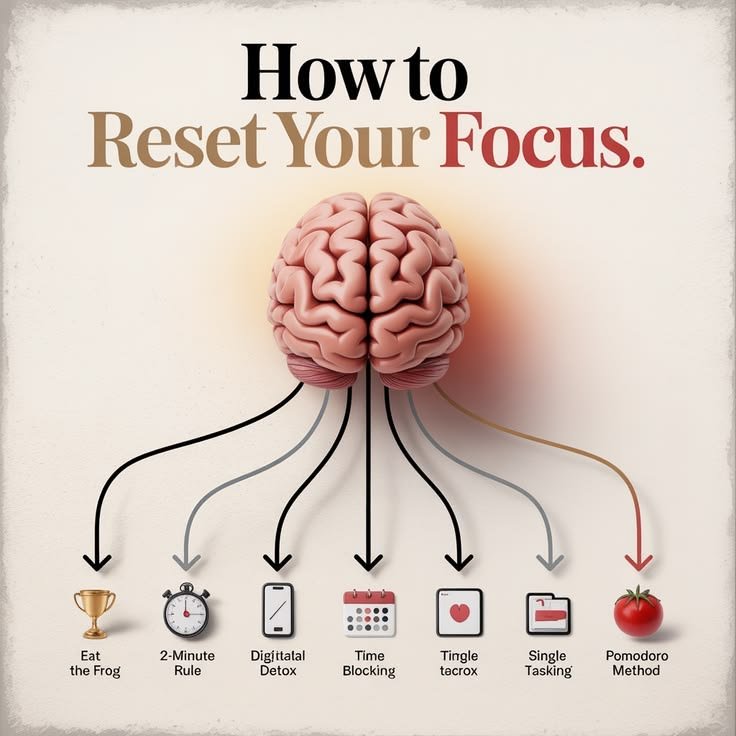
Visual clutter creates subconscious mental drag. A desk littered with old sticky notes, dirty coffee mugs, and loose papers forces your visual cortex to continuously process surrounding stimuli, drawing subtle energy away from your primary task.
Keep your physical workspace minimalist:
-
Keep only your laptop, notebook, pen, and water glass on your primary desk surface.
-
Close browser tabs that are unrelated to your immediate task.
-
Hide dock icons or taskbars if they display glowing notification badges.
Creating a clean physical and digital perimeter removes ambient distractions, making it substantially easier to enter a deep flow state.
5. Take Real Screen-Free Midday Breaks
Eating lunch at your keyboard while scrolling through social media feeds or answering non-urgent emails does not count as a break. It keeps your nervous system in a state of mild arousal and digital consumption.
Protect your lunch break as a strict cognitive recovery zone:
-
Eat away from your primary work desk.
-
Avoid reading news or watching videos while eating.
-
Go for a 10-minute walk outside to get fresh air and stimulate blood flow to your brain.
If you find yourself arriving at your desk feeling exhausted or unfocused despite taking breaks, applying techniques from how to focus at work with brain fog will help you recalibrate your afternoon workload safely.
6. Batch Administrative and Communication Tasks
Constant real-time communication is the enemy of concentration. If you keep your email inbox open all day and reply to messages the moment they arrive, your focus will remain permanently fragmented.
Batch administrative tasks into dedicated time slots:
-
Check and process emails twice daily (e.g., 11:00 AM and 4:00 PM).
-
Reserve a 30-minute block in the late afternoon for quick team check-ins, filing receipts, and updating task boards.
-
Communicate your focus windows to your team so they know when to expect responses.
By batching low-cognitive chores, you protect uninterrupted blocks of time for deep, meaningful work.
7. Perform a 5-Minute Daily Shutdown Ritual
Ending your workday abruptly without closing loop items causes lingering work thoughts to follow you home, disrupting your evening rest and lowering your energy for the next day.
Spend the final 5 minutes of your workday executing a clean shutdown:
-
Review your calendar for upcoming meetings tomorrow.
-
Write down your top 1 to 3 priorities for the next morning on a paper notepad.
-
Close all browser tabs, save your open files, and shut down your computer.
Establishing a firm end-of-day boundary clears your working memory. If you work from home and struggle to separate your job from your personal life, incorporating simple steps to improve work life balance in a remote environment will ensure you recharge fully overnight.
Common Distraction Traps to Eliminate
To protect your daily routines, watch out for these focus-killing habits:
-
Checking Phone Notifications in Bed: Reaching for your phone first thing in the morning puts your mind in a reactive state before your day even starts.
-
Leaving Multiple Chat Tabs Open: Mute non-critical communication channels during deep work blocks.
-
Over-Scheduling Meetings: Protect blocks of “maker time” on your calendar so your entire day is not consumed by back-to-back video calls.
Daily Focus Habit Checklist
-
Morning: Get direct sunlight, hydrate, and complete your top priority task before checking email.
-
Midday: Execute 45-minute focus sprints, clean your desk workspace, and take a screen-free lunch.
-
Evening: Batch end-of-day messages, write down tomorrow’s priority list, and perform a full digital shutdown.
Building strong workplace concentration is a deliberate daily habit. By structuring your morning routines, honoring deep work windows, and taking intentional recovery breaks, you can achieve higher productivity while protecting your mental wellness.
Want More Insights to Grow Your Digital Presence & Daily Productivity?
Whether you need to fix your website’s technical performance or build a smarter, burnout-free work routine, NewsUpTo delivers practical guides to keep you ahead.





Leave feedback about this