

As blockchain adoption grows, networks like Ethereum and Bitcoin frequently face network congestion, leading to slow transaction times and skyrocketing gas fees. To solve these performance bottlenecks without sacrificing decentralized security, developers created a two-tiered system: Layer 1 and Layer 2.
Understanding how these architectural layers interact helps users navigate Web3 applications, save significantly on transaction fees, and understand modern blockchain infrastructure.
Below is a Layer 1 vs Layer 2 blockchain simple explanation that breaks down how both tiers work together to make decentralized networks scalable.
1. What Is a Layer 1 Blockchain?
A Layer 1 (L1) blockchain is the primary base protocol that maintains its own ledger, consensus mechanism, and native token. It acts as the ultimate source of truth and security for all transactions on its network.
-
Core Function: Layer 1 networks process, validate, and finalize transactions on their native blockchain.
-
Consensus Mechanisms: L1s rely on mechanisms like Proof of Work (PoW) or Proof of Stake (PoS) to ensure immutable security across decentralized nodes.
-
Prominent Layer 1 Examples: Bitcoin, Ethereum, Solana, and Avalanche.
-
The Scalability Challenge: Because every node must validate every single transaction to maintain maximum security, base layers can become slow and expensive during periods of high network activity.
2. What Is a Layer 2 Scaling Solution?
A Layer 2 (L2) network is a secondary protocol built directly on top of an existing Layer 1 blockchain to expand its throughput capacity.
-
Core Function: Layer 2 processes transactions off the main blockchain, taking the operational burden away from the congested base layer.
-
Bundling Mechanism (Rollups): L2 frameworks bundle dozens or hundreds of individual transactions together into a single compressed proof, sending it back to the Layer 1 network for permanent settlement.
-
Inherited Security: Because Layer 2 solutions periodically finalize batch records on Layer 1, they benefit from the underlying base layer’s robust security model.
-
Prominent Layer 2 Examples: Arbitrum, Optimism, Base, and Polygon.
To understand how daily trading activity impacts liquidity across these networks, see our guide on what is crypto market cap vs trading volume.
3. Real-World Highway Analogy
Think of Layer 1 as a busy two-lane highway connecting two major cities. During peak hours, thousands of cars try to use the same lanes at once, causing heavy traffic jams and high toll fees.
Layer 2 is an express elevated train built directly above that highway. Hundreds of passengers board a single train car instead of driving individual automobiles. The train travels quickly across the same path, relieving highway congestion and lowering travel costs for everyone while relying on the same foundational bridge supports.
4. Layer 1 vs Layer 2 Comparison Table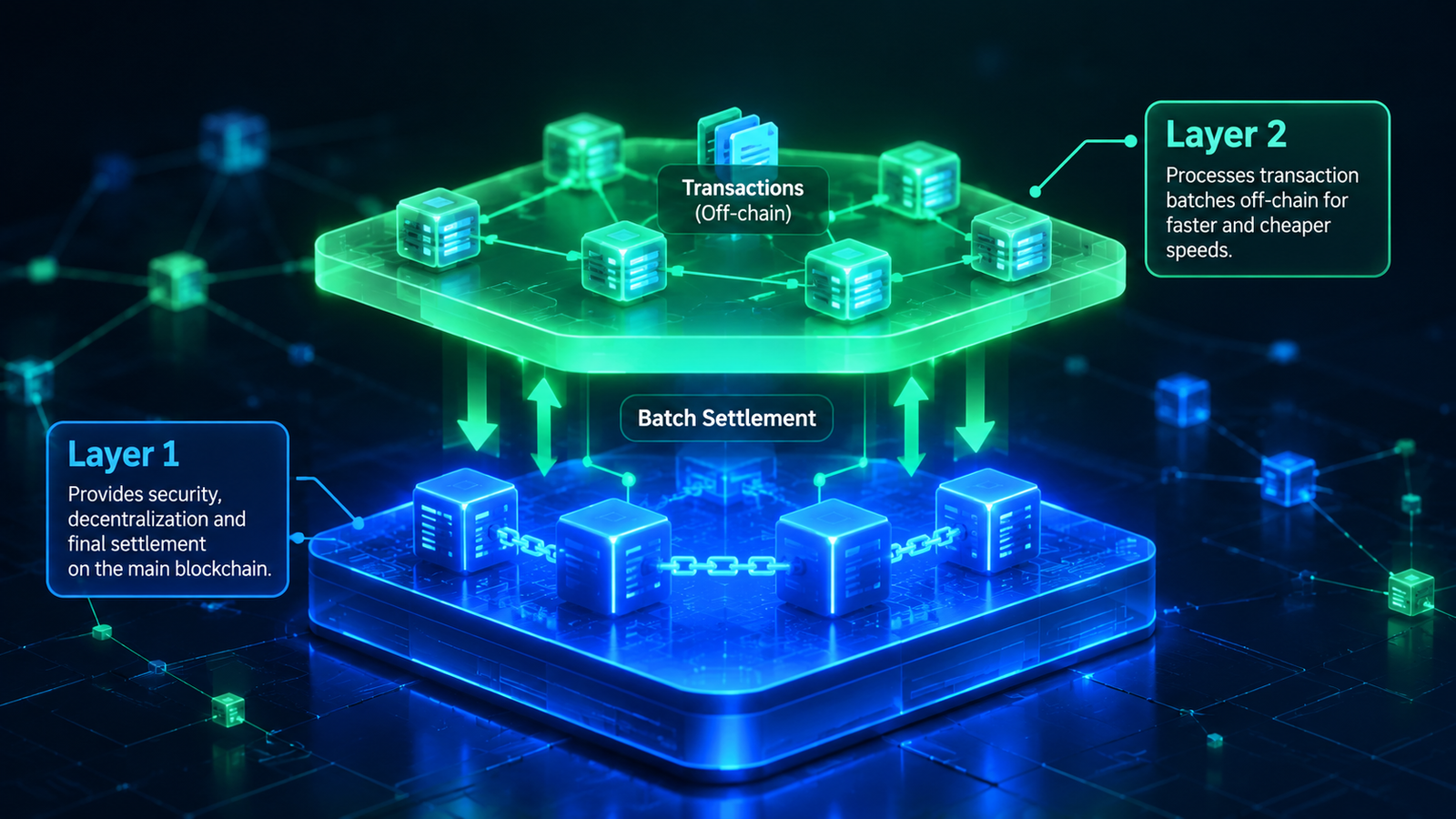
| Feature | Layer 1 Blockchain | Layer 2 Scaling Network |
| Primary Role | Base architecture, consensus, and security | Transaction speed, throughput, and fee reduction |
| Execution Location | On-chain (direct base ledger validation) | Off-chain execution with on-chain settlement |
| Transaction Speed | Slower (limited by block space) | Extremely fast (thousands of transactions per second) |
| Gas Fees | High during network congestion | Up to 90% to 99% cheaper than Layer 1 |
| Examples | Bitcoin, Ethereum, Solana | Arbitrum, Optimism, Polygon, Lightning Network |
5. Why Both Layers Are Essential for the Future of Web3
Neither layer replaces the other; rather, they work in harmony to solve the blockchain trilemma (balancing security, decentralization, and scalability).
-
Layer 1 Provides Security and Trust: Base layers remain the master registry for total value storage, smart contract execution, and immutable data settlement.
-
Layer 2 Enables Everyday Usability: L2 networks make decentralized finance (DeFi), gaming, microtransactions, and NFT minting practical for everyday consumer adoption by offering near-instant speeds and minimal fees.
When placing orders on decentralised or centralized exchanges operating across these chains, learn how order types function in what is a crypto limit order vs market order. To keep your assets secure across both layers, store your recovery credentials safely using the practices in difference between hot wallet and cold wallet.
Want More Insights to Grow Your Digital Presence & Daily Productivity?
Whether you need to fix your website’s technical performance or build a smarter, burnout-free work routine, NewsUpTo delivers practical guides to keep you ahead.





Leave feedback about this