

How to Build Long-Term Wealth and Security.
Financial freedom is a goal that many people want to achieve, but few understand what it actually means. For some, financial freedom means having enough savings to handle unexpected expenses. For others, it means owning a successful business, having multiple sources of income, or being able to make important life decisions without constantly worrying about money.
Financial freedom does not necessarily mean becoming extremely wealthy. Instead, it means reaching a point where your finances are organized well enough to support your needs, goals, and future plans. Achieving this position requires patience, discipline, financial knowledge, and consistent action.
In a world where living costs continue to change and financial responsibilities can increase over time, understanding how to build long-term financial security has become more important than ever.
What Does Financial Freedom Mean?
Financial freedom can have a different meaning for every person. At its core, it means having enough control over your finances that money does not constantly limit your important decisions.
A financially secure person may have manageable expenses, emergency savings, limited high-cost debt, and investments or other assets that support long-term goals. The exact amount of money required depends on an individual’s lifestyle, responsibilities, location, and future plans.
Financial freedom is therefore not a specific number in a bank account. It is a combination of financial stability, preparation, and independence.
The journey usually begins with understanding your current financial situation. Without knowing how much you earn, spend, save, and owe, it is difficult to create a realistic plan for the future.
Start With Your Financial Foundation
Before thinking about building wealth, it is important to establish a strong financial foundation. This means understanding your regular income and necessary expenses.
Start by listing your major monthly costs. These might include housing, food, transportation, education, utilities, healthcare, communication, and other essential expenses.
Once these costs are clear, you can compare them with your income. This simple exercise can reveal whether your current spending habits are sustainable.
A strong foundation does not require eliminating every enjoyable activity. Instead, it means making sure that important financial responsibilities are handled before unnecessary spending takes priority.
Good financial habits developed at this stage can make future wealth-building much easier.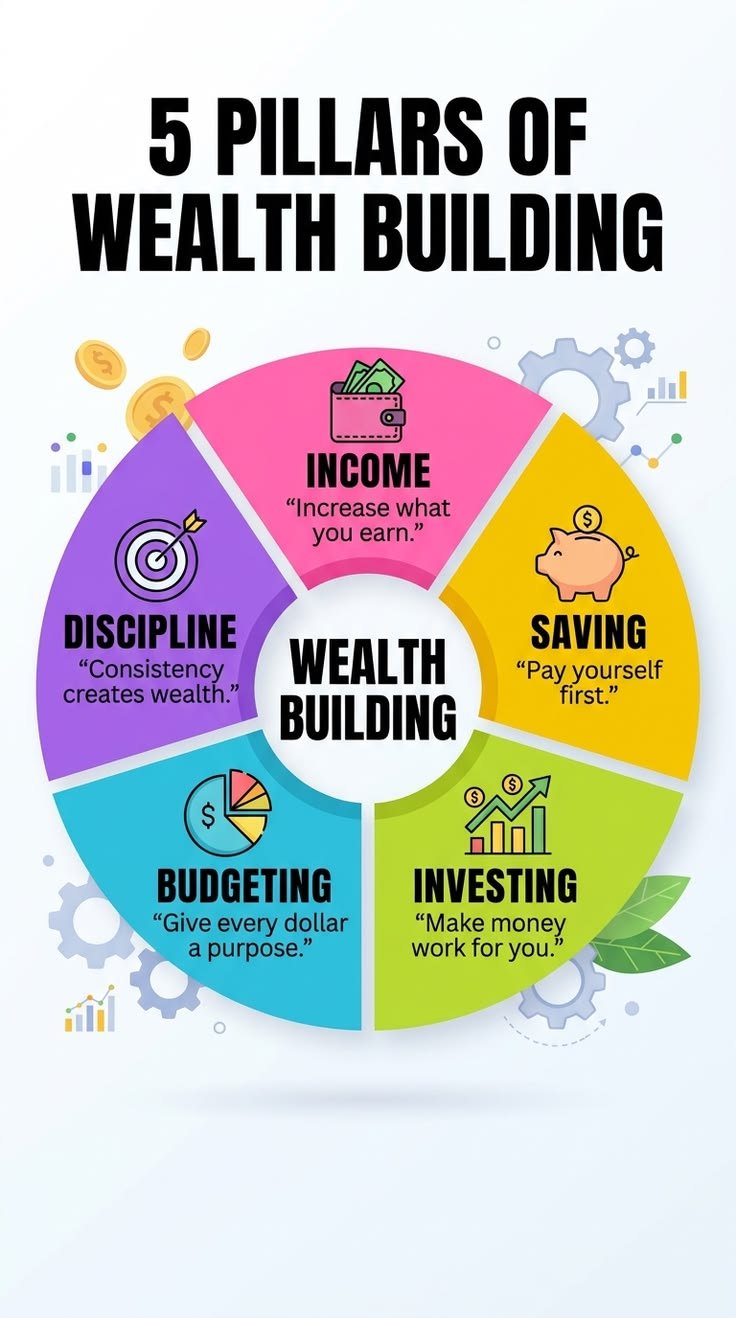
Build an Emergency Reserve
Unexpected expenses can interrupt even the best financial plans. A sudden repair, medical cost, temporary income reduction, or other emergency can create financial pressure.
An emergency reserve provides a financial cushion for these situations. The amount needed will depend on personal circumstances, but the main objective is to have accessible savings that are separate from money intended for everyday spending.
Building an emergency fund can take time. You do not need to create the entire reserve immediately. Setting aside a manageable amount regularly can gradually build a useful financial safety net.
The most important part is consistency. Even small contributions can become meaningful when maintained over a long period.
Increase Your Earning Potential
Saving money is important, but long-term financial progress can also depend on increasing income.
There are many ways people can improve their earning potential. Developing professional skills, gaining qualifications, learning technology, improving communication abilities, or developing specialized expertise can create new career opportunities.
For entrepreneurs and freelancers, increasing income may involve improving services, reaching new customers, developing products, or expanding into additional markets.
The goal should not simply be to work more hours. Instead, focus on building valuable skills and finding opportunities that can increase the value of your work.
Investing in yourself can therefore be one of the most valuable forms of financial investment.
Create Multiple Sources of Income
Relying on a single source of income can sometimes create financial vulnerability. If that income suddenly decreases or disappears, expenses may become difficult to manage.
Multiple income sources can provide additional financial flexibility. Depending on individual circumstances and applicable laws, these may include freelance work, a small business, royalties, rental income, or returns from investments.
However, developing additional income should be approached realistically. Every opportunity has its own risks, costs, and requirements.
People should be careful about online claims promising instant or effortless income. Sustainable income usually requires useful skills, time, planning, and consistent effort.
Understand the Power of Long-Term Investing
One of the major differences between simply saving money and building long-term wealth is the potential role of investing.
Investing involves putting money into assets with the expectation of generating returns over time. Depending on the investment, returns may come through price appreciation, interest, dividends, or other forms of income.
Long-term investing focuses on allowing investments time to grow rather than trying to predict every short-term market movement.
However, investments are not guaranteed to increase in value. Different assets carry different levels of risk, and investors can lose money.
Before investing, it is important to understand the asset, fees, risks, time horizon, and purpose of the investment.
The Importance of Compound Growth
Compound growth is an important concept in long-term finance. It occurs when returns generated by an investment are reinvested, allowing future returns to potentially be earned on both the original amount and previous returns.
Time can be an important factor in this process. Starting earlier can provide more time for potential growth to accumulate.
For example, regularly investing a modest amount over many years may potentially produce a larger result than investing the same amount for a much shorter period, depending on the returns and circumstances.
Compound growth does not guarantee profits, but it demonstrates why consistency and patience can be important in long-term financial planning.
Avoid Lifestyle Inflation
As income increases, it can be tempting to increase spending at the same rate. This is sometimes called lifestyle inflation.
For example, someone may receive a higher salary and immediately upgrade their phone, vehicle, clothing, entertainment, and other expenses. While enjoying the benefits of higher income is not necessarily a problem, continuously increasing expenses can prevent wealth from growing.
A better approach can be to divide additional income between current enjoyment, savings, debt reduction, and long-term investments.
This allows people to improve their lifestyle while also strengthening their financial position.
Make Debt Work for You
Debt is not automatically good or bad. Its impact depends on the reason for borrowing, the cost of the debt, and the ability to repay it.
Some forms of borrowing may help finance education, business activities, housing, or other long-term goals. Other forms of high-cost debt can become difficult to manage when balances continue to grow.
Understanding interest rates, fees, repayment schedules, and total repayment costs is essential before accepting a loan or using credit.
If someone has multiple debts, creating a clear repayment strategy can help organize priorities. Reducing expensive debt can also free future income for savings and other goals.
Protect Your Financial Progress
Building wealth is only one part of financial security. Protecting what you have is equally important.
Insurance can play a role in protecting people against certain financial risks. Depending on individual circumstances, this may include health, property, vehicle, or other forms of appropriate coverage.
Keeping important financial documents organized is also useful. People should understand where important records are stored and take reasonable steps to protect personal financial information.
Digital security has become particularly important. Strong passwords, secure devices, multi-factor authentication, and caution with suspicious messages can reduce the risk of financial fraud.
Set Long-Term Financial Goals
Financial freedom becomes easier to pursue when goals are clearly defined.
Instead of simply deciding to “become wealthy,” create measurable objectives. You might want to build an emergency fund, eliminate high-cost debt, save for education, purchase a home, start a business, or prepare for future financial responsibilities.
Divide large goals into smaller steps. A large target can feel overwhelming, but smaller monthly or yearly milestones make progress easier to measure.
It is also important to review goals regularly. Life circumstances change, and a financial plan should be flexible enough to change with them.
Develop Financial Discipline
Knowledge alone does not guarantee financial success. Habits and behavior matter just as much.
Financial discipline means making decisions based on priorities rather than temporary emotions. Before making a major purchase, ask whether it is necessary, affordable, and consistent with your financial goals.
A simple waiting period before non-essential purchases can sometimes prevent impulse spending.
Tracking expenses, reviewing accounts regularly, and maintaining savings habits can also improve financial awareness.
Small actions repeated over many years can have a significant effect on financial stability.
Avoid Get-Rich-Quick Promises
The desire for financial freedom can make people vulnerable to unrealistic promises. Advertisements or online personalities may claim that people can become wealthy quickly with little effort or risk.
These claims should be treated carefully.
Legitimate financial opportunities generally involve some combination of risk, effort, knowledge, time, or capital. If someone promises guaranteed high returns with no risk, it is important to investigate carefully before committing money.
Learning to identify financial scams is an essential part of modern financial literacy.
Financial Freedom Takes Time
One of the biggest misconceptions about wealth is that it can be created overnight. In reality, sustainable financial progress usually takes time.
There may be periods when progress feels slow. Unexpected expenses can interrupt savings. Investments may experience declines. Income may change. These situations are normal parts of financial life.
The key is to continue learning, review the plan, and make adjustments when necessary.
Financial freedom is not about perfection. It is about gradually moving toward greater stability and independence.
Conclusion
Financial freedom is not simply about having a large amount of money. It is about building a financial system that supports your present needs while preparing you for the future.
Creating an emergency reserve, improving earning potential, managing debt responsibly, developing multiple income sources, investing for the long term, protecting financial assets, and maintaining disciplined spending habits can all contribute to greater financial security.
The journey will look different for every individual. Some people may focus on building a business, while others may prioritize education, investments, savings, or debt reduction.
What matters most is starting with realistic goals and remaining consistent. Financial freedom is built through many small decisions made over time. With patience, knowledge, and responsible planning, individuals can create a stronger financial foundation and move closer to the freedom they want.






Leave feedback about this