
Building an emergency fund is the foundation of personal financial security, yet leaving thousands of dollars sitting in a traditional checking account causes your cash to lose purchasing power to inflation every single year.
When looking for safe, risk-free places to store three to six months of living expenses, two options consistently stand out: High-Yield Savings Accounts (HYSAs) and Short-Term U.S. Treasury Bills (T-Bills).
Both vehicles protect your principal and pay competitive interest rates, but they operate under different rules regarding instant liquidity, tax treatment, and account mechanics. Choosing the wrong structure can either cost you unnecessary state income taxes or lock up your cash right when an urgent medical or home repair bill arrives.
Here is a complete comparison of High-Yield Savings Accounts versus Short-Term Treasury Bills to help you decide where to park your emergency cash.
HYSA vs. Short-Term T-Bills for Emergency Cash
For most savers, High-Yield Savings Accounts win for immediate, same-day liquidity, while Short-Term Treasury Bills win for after-tax yield in high-tax states.
-
Choose a High-Yield Savings Account (HYSA) for your first 1 to 2 months of living expenses where instant bank transfers, ATM access, and zero maturity waiting periods matter most.
-
Choose 4-Week or 8-Week Treasury Bills for the remaining 3 to 6 months of your emergency reserve, especially if you live in a state with high income taxes, because T-bill interest is completely exempt from state and local taxes.
-
Combine Both: Using a hybrid two-tier system gives you instant emergency cash on day one while maximizing tax-free yield on your deeper reserves.
Side-by-Side Comparison: HYSA vs. Short-Term T-Bills
| Feature / Metric | High-Yield Savings Account (HYSA) | Short-Term Treasury Bills (4- to 13-Week) |
| Liquidity & Access | Instant to 1 Business Day via ACH or wire transfer. | Locked Until Maturity (unless sold early on secondary brokerage market). |
| Safety & Backing | FDIC Insured up to $250,000 per depositor, per bank. | Backed by Full Faith & Credit of the U.S. Federal Government. |
| Federal Income Tax | Taxed as ordinary income. | Taxed as ordinary income. |
| State & Local Tax | Taxed at your standard state/local income tax rate. | 100% Exempt from all state and local income taxes. |
| Interest Rate Lock | Variable (banks can lower APY at any time). | Fixed for the duration of the bill term (4, 8, 13, 17, or 26 weeks). |
| Minimum Deposit | Often $0 to $100 depending on the bank. | $100 minimum via TreasuryDirect or major brokerages. |
To verify deposit coverage limits and institutional rules, review the FDIC Deposit Insurance FAQs.
Deep Dive: High-Yield Savings Accounts (HYSAs)
A High-Yield Savings Account is an online savings account offered by digital banks or credit unions that pays significantly higher annual percentage yields (APY) than traditional brick-and-mortar banks.
Key Advantages of an HYSA
-
Frictionless Emergency Access: When your car transmission fails on a Saturday afternoon, you can transfer funds from an HYSA to your linked checking account within hours.
-
No Maturity Dates: You never have to track auction schedules, maturity windows, or reinvestment dates.
-
Simple Tax Reporting: Your bank issues a single Form 1099-INT at the end of the year, keeping tax filing straightforward.
Key Drawbacks of an HYSA
-
State Tax Drag: If you live in high-tax states like California, New York, New Jersey, or Massachusetts, state income taxes can reduce your effective yield by 5% to 10%+.
-
Variable Rate Risk: Banks adjust HYSA yields whenever the Federal Reserve shifts benchmark interest rates, meaning your return can drop overnight without notice.
If you are still building your initial cash cushion while managing fluctuating income, read our guide on debt payoff strategies freelancers variable income to balance debt reduction with savings goals.
Deep Dive: Short-Term U.S. Treasury Bills (T-Bills)
Treasury Bills are short-term debt obligations issued directly by the U.S. Department of the Treasury with maturities ranging from four weeks to one year. Instead of paying monthly interest, T-bills are sold at a discount to their face value and pay out the full face value at maturity.
For example, you might pay $996 for a 4-week $1,000 T-bill and receive the full $1,000 back 28 days later, earning $4 in interest.
Key Advantages of Short-Term T-Bills
-
State and Local Tax Exemption: Under federal law, interest earned on U.S. Treasury securities is completely exempt from state and local income taxes. In high-tax jurisdictions, a 4.5% T-bill yield often beats a 4.75% HYSA yield after taxes.
-
Locked-In Yield: Once you purchase a 4-week or 13-week T-bill, your yield is guaranteed until maturity, regardless of rate cuts during that window.
-
Zero Default Risk: Treasuries are widely considered the safest liquid asset in global finance.
Key Drawbacks of Short-Term T-Bills
-
Settlement Delays: If you buy through TreasuryDirect, funds remain locked until the bill matures. If you purchase T-bills through a private brokerage (such as Fidelity, Vanguard, or Charles Schwab), you can sell them early on the secondary market, though settlement still takes one business day (T+1).
-
Clunky Direct Interface: Navigating the government portal requires extra administrative steps compared to modern mobile banking apps.
How to Build a “Two-Tier” Hybrid Emergency Fund
You do not have to choose exclusively between an HYSA and T-bills. Financial planners often recommend splitting a six-month emergency fund into two strategic buckets:
Setting Up a 4-Week T-Bill Ladder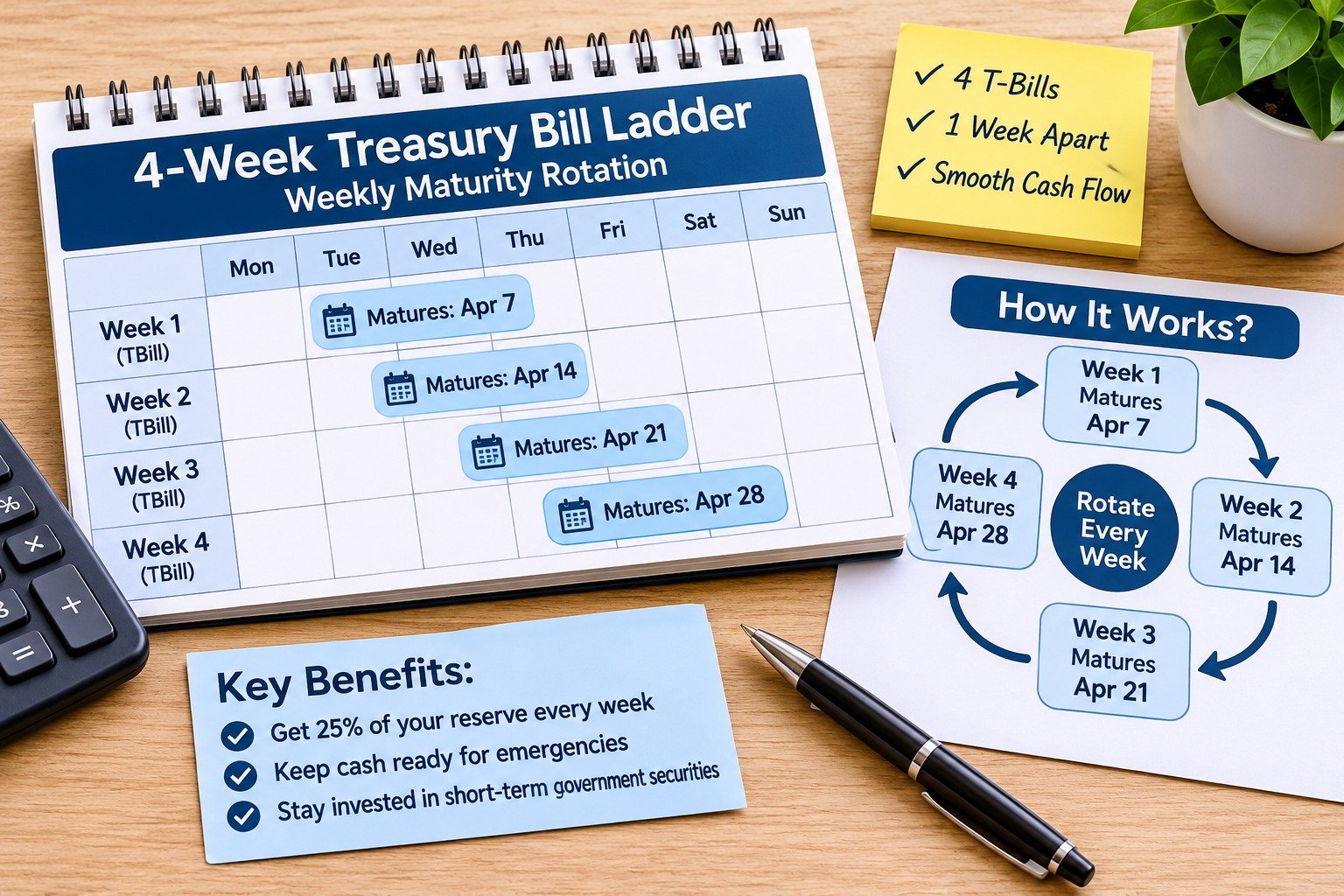
To avoid locking up your entire Tier 2 reserve at once, divide your T-bill allocation into four equal parts and buy one 4-week T-bill each week for four consecutive weeks, setting each to automatically reinvest.
Once established, 25% of your T-bill fund matures every single Tuesday, giving you weekly liquidity alongside full state tax exemptions.
For additional foundational advice on calculating target savings milestones, visit the CFPB Essential Guide to Building an Emergency Fund.
If you are looking to grow your monthly cash surplus so you can fund both tiers faster, explore our guides on how to package sell digital templates micro saas and build sell notion systems small business operations.
Want More Insights to Grow Your Digital Presence & Daily Productivity?
Whether you need to fix your website’s technical performance or build a smarter, burnout-free work routine, NewsUp To delivers practical guides to keep you ahead.






Leave feedback about this