
Sitting at a desk for eight or more hours every day places continuous compressive load on the lower lumbar spine. Over time, prolonged sitting switches off your deep abdominal stabilizers, deactivates your glute muscles, and shortens your hip flexors. This muscular imbalance pulls the pelvis forward and triggers chronic, dull lower back aches by mid-afternoon.
While standing up to walk or stretch every hour is ideal, back-to-back video calls, tight project deadlines, and shared office environments often keep you anchored to your chair.
The practical solution is integrating isometric desk exercises into your daily routine.
Isometric exercises involve contracting specific muscle fibers without changing the angle of your joints or moving your spine. Because they require zero visible motion, you can strengthen your deep core, wake up dormant glutes, and relieve lumbar tension right at your desk without breaking a sweat or drawing attention from coworkers.
Here is your complete guide to preventing lower back pain using targeted isometric desk holds.
How Do Isometric Desk Exercises Relieve Back Pain?
Isometric desk exercises relieve lower back pain by reactivating the muscles responsible for holding your pelvis and spine in neutral alignment while seated. According to physical medicine specialists at the Cleveland Clinic, static muscle contractions build endurance and joint stability safely without placing dynamic shear stress on sensitive tissues.
Perform these five discreet isometric holds every two hours during your workday:
-
Seated Transverse Abdominis Brace: Tightens your deep natural core belt to offload lumbar disc pressure.
-
Chair Glute Squeezes: Reverses “gluteal amnesia” so lower back muscles stop overcompensating.
-
Under-Desk Palm Press: Engages the latissimus dorsi and mid-back to pull rounded shoulders upright.
-
Seated Inner-Thigh Press: Stabilizes the pelvic floor and sacroiliac (SI) joints.
-
Heel-to-Floor Isometric Pull: Activates dormant hamstrings to balance tight hip flexors.
The 5-Exercise Isometric Desk Routine Matrix
Use this quick-reference schedule to run through a complete spinal stabilization circuit in under five minutes.
| Exercise Name | Primary Muscle Target | Hold Time | Repetitions | Biomechanical Benefit |
| Seated Abdominal Brace | Transverse Abdominis | 10–15 Seconds | 5 Holds | Creates intra-abdominal pressure to support lumbar discs |
| Chair Glute Squeezes | Gluteus Maximus | 10 Seconds | 10 Holds | Restores hip extension tone and reduces lumbar strain |
| Under-Desk Palm Press | Latissimus Dorsi & Traps | 10 Seconds | 5 Holds | Counteracts upper-back slouching and forward head posture |
| Seated Thigh Squeeze | Hip Adductors & Pelvic Floor | 10–15 Seconds | 5 Holds | Aligns pelvic symmetry and stabilizes the lower spine |
| Isometric Heel Drag | Hamstrings & Posterior Chain | 10 Seconds | 6 Holds | Relieves anterior pelvic tilt caused by tight hip flexors |
Step-by-Step Instructions for Each Isometric Hold
1. Seated Transverse Abdominis Brace
Your transverse abdominis wraps horizontally around your midsection like an internal weightlifting belt. Keeping this muscle active prevents your lower spine from collapsing into your chair.
-
Setup: Sit upright near the front edge of your chair with your feet planted flat on the floor and knees bent at 90 degrees.
-
Execution: Take a slow breath in. As you exhale, draw your belly button gently inward toward your spine without holding your breath. Place both palms flat on top of your thighs and press downward while simultaneously trying to lift your knees upward into your hands.
-
Hold: Maintain firm, steady tension for 10 to 15 seconds while breathing smoothly. Release slowly and repeat 5 times.
2. Chair Glute Squeezes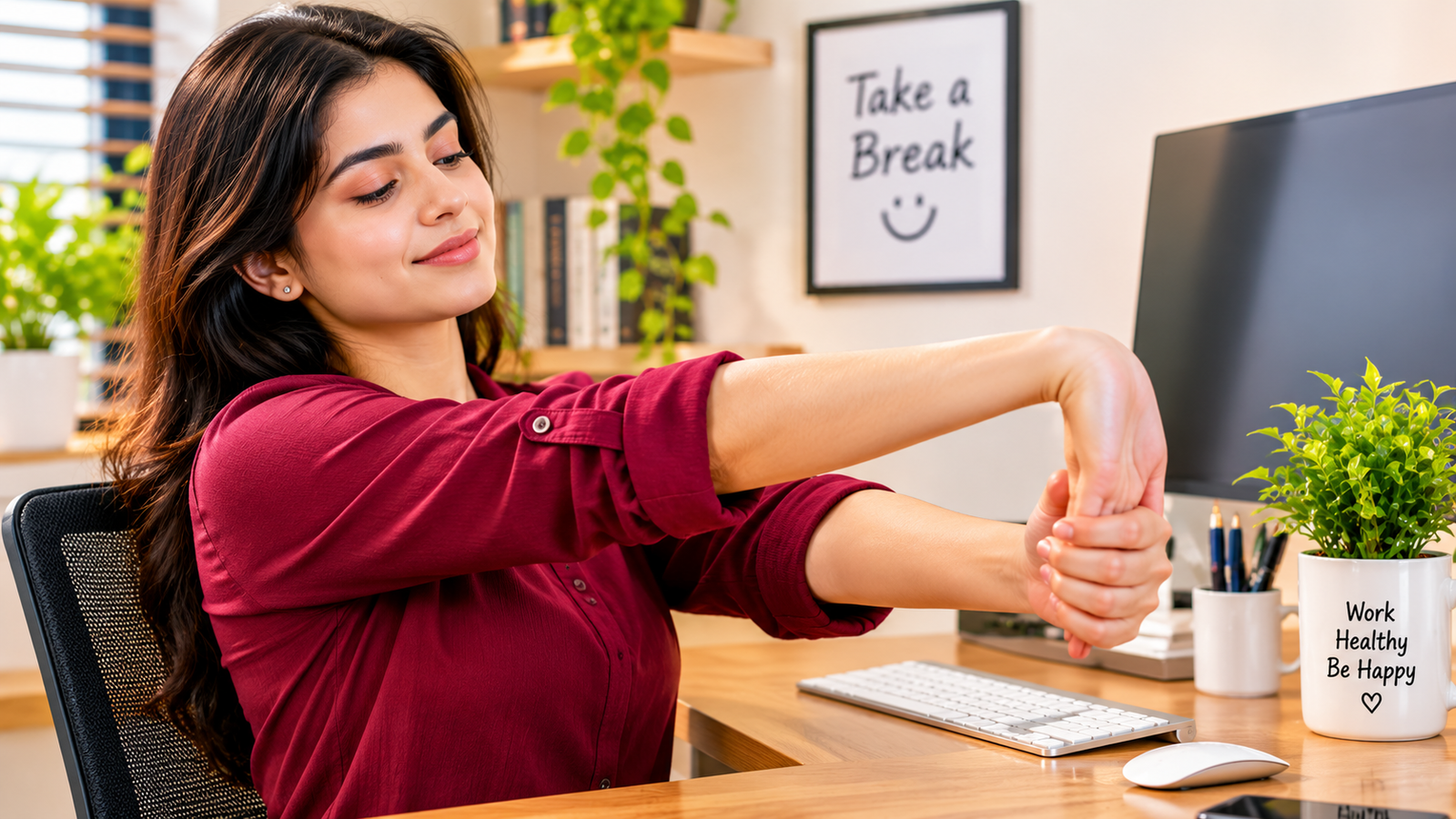
Hours of sitting compress the gluteus maximus and reduce blood flow, a condition physical therapists call gluteal amnesia. When your glutes fail to fire, your lower lumbar erector muscles work overtime to stabilize your torso.
-
Setup: Sit tall with your shoulders stacked directly over your hips and both feet flat on the ground.
-
Execution: Squeeze both glute muscles together as firmly as possible without arching your lower back or lifting your heels. You should feel yourself rise roughly half an inch in your seat.
-
Hold: Hold peak contraction for 10 seconds, relax completely for 5 seconds, and perform 10 repetitions.
3. Under-Desk Palm Press
Slumping forward over a keyboard rounds the thoracic spine, forcing the lower back to curve unnaturally to compensate.
-
Setup: Slide your chair close to your desk so your torso is upright and your elbows are bent at 90 degrees by your sides.
-
Execution: Place both palms flat against the underside of your desktop. Press upward into the desk as if attempting to lift it off the floor, while actively pulling your shoulder blades down and back.
-
Hold: Sustain upward pressure for 10 seconds. Relax your arms and repeat 5 times.
4. Seated Inner-Thigh (Adductor) Press
Weak inner-thigh muscles contribute to pelvic instability, which often manifests as one-sided lower back ache.
-
Setup: Sit upright with your knees bent at 90 degrees. Place a firm cushion, rolled-up jacket, or clenched fists between your knees.
-
Execution: Squeeze your knees inward against the object with steady, controlled force.
-
Hold: Hold the inward squeeze for 10 to 15 seconds, release, and repeat 5 times.
5. Isometric Heel Drag
Tight hip flexors pull the front of the pelvis downward, creating excessive lower back arch. Engaging the hamstrings pulls the pelvis back into neutral alignment.
-
Setup: Sit upright with your feet flat on the floor slightly ahead of your knees.
-
Execution: Dig your heels firmly into the floor and pull backward as if trying to slide your chair forward, without actually letting your feet or chair move.
-
Hold: Hold the hamstring contraction for 10 seconds, relax, and complete 6 repetitions.
Pairing Isometric Exercises with Proper Workstation Ergonomics
Isometric contractions strengthen your support muscles, but poor workstation geometry will quickly fatigue them again. According to ergonomic standards published by the Occupational Safety and Health Administration (OSHA), keeping your joints in neutral alignment minimizes static muscle fatigue throughout the workday.
Workstation Calibration Checklist
-
Monitor Height: Position the top third of your screen at eye level so you do not crane your neck forward.
-
Lumbar Contact: Adjust your backrest or place a small rolled towel in the natural curve of your lower back.
-
Foot Support: Keep both feet flat on the floor or resting on a firm footrest so your thighs remain parallel to the ground.
For detailed visual guidelines on adjusting chair height, armrests, and keyboard distance, review the Mayo Clinic Guide to Office Ergonomics.
If you work from home in a compact living space, explore our recommendations for budget ergonomic workstation gear for renters small apartments to upgrade your setup without permanent modifications.
Building a Sustainable Workday Movement Habit
Consistency matters far more than intensity when preventing occupational back pain. Rather than relying on memory, attach your isometric routine to existing daily triggers:
-
Every Email Batch: Perform 5 seated abdominal braces before opening your inbox in the morning and after lunch.
-
Every Video Call: Run through 10 chair glute squeezes while listening during long status meetings.
-
Every Water Refill: Complete 5 under-desk palm presses each time you sit back down with a fresh glass of water.
Pair daytime spinal care with better overnight physical recovery by learning how to use smart wearables oura data optimize deep sleep, and reduce systemic inflammation during busy workweeks with low-fodmap meal prep ideas busy professionals. If your team spends too many hours trapped in back-to-back calls, share our async communication playbook distributed remote teams to reclaim flexible movement breaks.
Want More Insights to Grow Your Digital Presence & Daily Productivity?
Whether you need to fix your website’s technical performance or build a smarter, burnout-free work routine, NewsUp To delivers practical guides to keep you ahead.




Leave feedback about this