
Modern Debt Payoff Strategies for Freelancers and Variable Income Earners
Earning a variable income provides incredible creative freedom and earning upside, but it introduces a major financial stressor when monthly bills arrive. For freelancers, independent contractors, and commission-based professionals, one slow month can derail a traditional debt repayment plan.
Standard personal finance advice like allocating a fixed $500 every single month toward credit card debt assumes you receive a steady paycheck on the 1st and 15th. When your income swings wildly from $3,000 in a lean month to $9,000 in a banner month, rigid budgeting frameworks usually fail, leading to missed payments and compounding interest charges.
To conquer debt without sacrificing financial stability, variable income earners need a flexible system.
Here is your complete playbook for adapting debt payoff strategies to fit an unpredictable freelance cash flow.
How Do Freelancers Pay Off Debt with Unpredictable Income?
Successfully eliminating debt on a variable income requires shifting away from fixed dollar quotas toward percentage-based thresholds and buffer accounts:
-
Establish a Minimum Baseline Budget: Calculate your absolute bare-minimum living expenses (housing, food, utilities, minimum debt payments) to know your baseline cash need.
-
Implement the “Income Smoothing” Buffer: Funnel surplus earnings from high-income months into a cash buffer account so you can pay yourself a consistent salary every month.
-
Use Percentage-Based Debt Allocations: Instead of committing to a fixed monthly debt payment, allocate a specific percentage of every client invoice toward principal reduction.
-
Choose Your Repay Method: Adapt either the Debt Snowball or Debt Avalanche method using dynamic payment tiers tied to your actual monthly revenue.
According to household financial research published by the Federal Reserve Financial Stability Reports, maintaining liquid cash reserves is the single most effective defense against unexpected income shocks and high-interest debt accumulation.
The Variable Income Debt Payoff Framework
| Income Tier | Monthly Cash Flow Example | Allocation Rule for Debt Payoff |
| Lean Month | Income falls below your baseline needs. | Pay Minimums Only on all debts. Protect cash reserves. |
| Normal Month | Income matches your average projected revenue. | Pay minimums plus 10% to 15% of net revenue toward target debt. |
| Windfall Month | Income exceeds average revenue by 30%+. | Pay minimums plus 50% of the surplus directly toward principal. |
Step 1: Calculate Your True Baseline Operating Number
Before paying down extra debt aggressively, you must protect your business and personal solvency.
Many freelancers make the mistake of throwing every spare dollar at credit card debt during a great month, only to be forced to use those exact same credit cards to buy groceries during the next slow month. This creates a frustrating cycle of debt accumulation and repayment.
-
Determine Essential Expenses: Add up your rent or mortgage, utility bills, health insurance, basic groceries, and the minimum required payments on all debts. This is your survival baseline.
-
Separate Business and Personal Accounts: Maintain a dedicated business operating account. Never let client payments mix directly with personal spending money, as fluctuating tax obligations can distort your actual take-home pay.
For guidance on maximizing interest yields on surplus cash buffers, review our guide on high-yield savings accounts short-term treasury bills emergency funds.
Step 2: Build an Income Smoothing Buffer
Income smoothing is the secret weapon of successful variable income earners. Instead of living a feast-or-famine lifestyle based on when invoices clear, you create an internal salary system.
-
The Target: Build a 1-to-2-month buffer fund inside a high-yield savings account.
-
The Mechanism: When you have a $10,000 month, do not inflate your lifestyle. Transfer your standard baseline salary into your personal checking account, leave estimated taxes in your tax account, and sweep the remaining surplus into your income buffer.
-
The Payoff: During a $2,000 slow month, draw from your buffer account to top up your salary, ensuring you never miss a debt payment or panic about cash flow.
Step 3: Choose Your Debt Repay Strategy (Snowball vs. Avalanche)
Once your baseline budget and income buffer are secure, you can attack your remaining consumer debt using one of two proven mathematical methods.
1. The Debt Snowball Method
-
How It Works: You list all your debts from smallest total balance to largest balance, regardless of interest rate. You pay minimums on everything, and throw every extra dollar at the smallest balance first.
-
Why Freelancers Like It: Quick psychological wins. Crossing out a small $400 credit card balance early builds momentum and simplifies your monthly bill-paying routine when cash flow fluctuates.
2. The Debt Avalanche Method
-
How It Works: You list debts from highest interest rate to lowest interest rate. You pay minimums on everything, and put all extra cash toward the highest-APR debt.
-
Why Freelancers Like It: Mathematically optimal. It minimizes the total amount of interest paid over time, which is especially critical when variable income limits how much extra cash you can put toward principal.
Review broader consumer credit guidelines and debt resolution frameworks through the Consumer Financial Protection Bureau (CFPB) Debt Guide.
Step 4: Automate Percentage-Based Debt Sweeps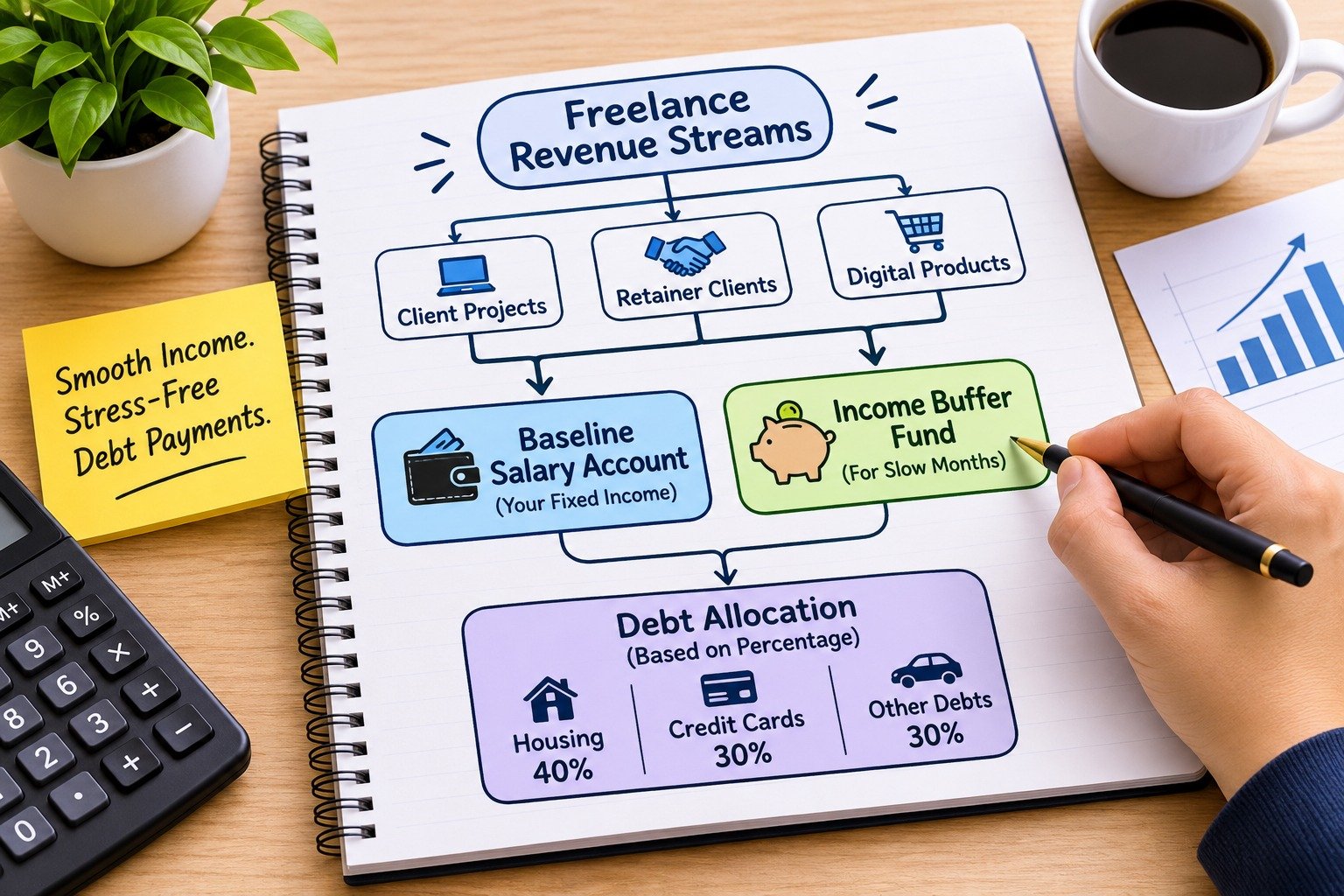
Because your income changes every month, setting up a fixed auto-pay amount for debt reduction can lead to overdraft fees during slow periods. Instead, automate your debt payments using percentage sweeps.
-
Step A: Set up automatic bank transfers to pay all mandatory minimum debt payments on the first of the month from your baseline salary account. This protects your credit score no matter what.
-
Step B: At the end of every week or month, calculate your variable freelance revenue. Automatically sweep 10% to 20% of net profits directly into your targeted payoff debt account.
Learn how solopreneurs package digital assets and manage consistent revenue streams in our guide on package sell digital templates micro saas.
To maintain mental clarity and lower stress during intense work sprints, ensure your rest cycles are optimized by reading use smart wearables oura data optimize deep sleep.
For consumer credit counseling resources and debt management plan options, visit the National Foundation for Credit Counseling (NFCC).
3 Traps to Avoid When Paying Off Debt as a Freelancer
-
Failing to Save for Quarterly Estimated Taxes: Many freelancers pay down credit cards with gross revenue, forgetting that federal, state, and self-employment taxes are still owed. Getting hit with a surprise tax bill forces many back into high-interest debt. Always set aside taxes before allocating money to debt payoff.
-
Depleting Working Capital: Never empty your business checking account to make a lump-sum debt payment if it leaves you with zero cash to pay software subscriptions, contractors, or immediate business expenses.
-
Ignoring 0% Balance Transfer Offers: If you have high-interest credit card debt and good credit, consolidating balances onto a 0% APR introductory balance transfer card can save hundreds in interest while your income fluctuates




Leave feedback about this