

Building long-term wealth does not require picking winning individual stocks, analyzing complex company financial charts, or timing market highs and lows. In fact, attempting to outsmart the stock market frequently leads to disappointing returns for everyday investors.
The most reliable, time-tested approach to growing your money involves passive investing through index funds and Exchange-Traded Funds (ETFs). By buying tiny pieces of hundreds or thousands of top companies simultaneously, you capture overall economic growth while lowering individual stock risks.
Here is a straightforward beginner’s guide to understanding index funds, ETFs, and how to use them to build lasting wealth.
1. Broad Market Diversification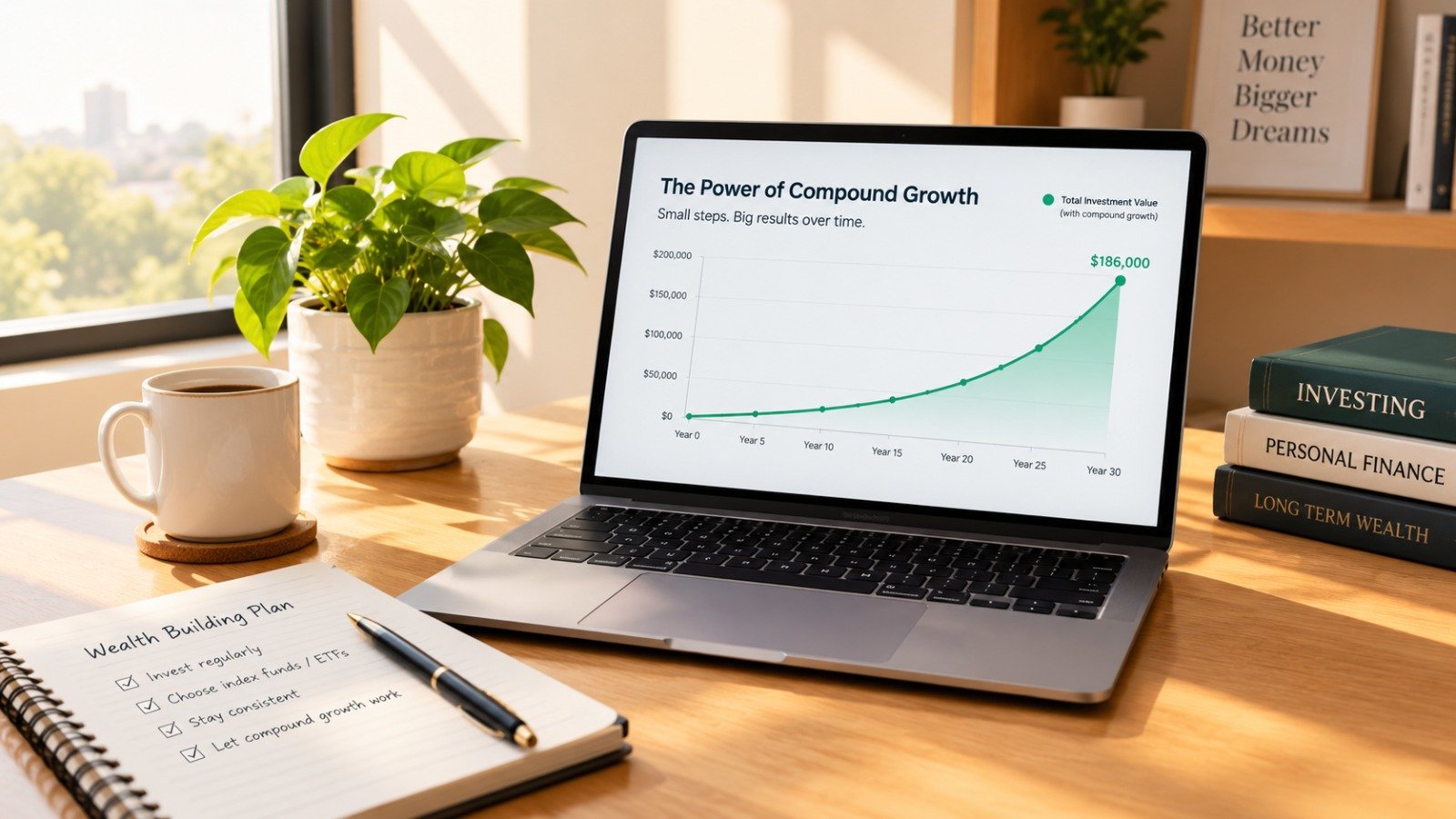
An S&P 500 index fund distributes your money across 500 of the largest publicly traded American companies (such as Apple, Microsoft, Amazon, and Berkshire Hathaway). If a few companies perform poorly, their drops are offset by growth in other sectors.
2. Extremely Low Fees (Expense Ratios)
Active mutual fund managers charge high annual fees (often 0.50% to 1.50% or higher) to select stocks. Passively managed index funds require minimal human management, keeping expense ratios as low as 0.03% to 0.08%. Lower management fees mean more of your money stays invested and compounds over decades.
3. Historical Reliability
Historically, the S&P 500 index has delivered an average annual return of roughly 10% over multi-decade periods. Over 15 to 20 years, passive index funds consistently outperform the vast majority of professional actively managed Wall Street funds.
Index Funds vs. ETFs: Understanding the Key Differences
While both index mutual funds and ETFs track underlying market indexes and offer broad diversification, they differ in how you purchase and trade them.
| Investment Feature | Index Mutual Funds | Exchange-Traded Funds (ETFs) |
| Trading Mechanism | Traded once daily after market close at Net Asset Value (NAV). | Traded continuously throughout the day on stock exchanges. |
| Minimum Investment | May require flat dollar minimums (e.g., $1,000 to $3,000) or $0 depending on provider. | Can be bought for the price of 1 share or fractional share. |
| Automatic Investing | Very easy to set up automated recurring monthly transfers. | Requires a broker that supports fractional shares and scheduled ETF buys. |
| Account Needs | Can be held in standard brokerage, IRA, or 401(k) accounts. | Traded via stock brokerage or Demat accounts. |
| Tax Efficiency | Slightly higher capital gains distributions in taxable accounts. | Highly tax-efficient structure due to “in-kind” share creation/redemption. |
How Compounding Builds Wealth Over Time
The real magic of index investing comes from compound growth—earning interest on your interest and returns on your returns.
Suppose you start investing 300 dollars a month into a low-cost S&P 500 index ETF with an average historical return of 8% annually (adjusted conservatively for inflation).
-
After 10 Years: You will have invested $36,000 out of pocket, and your account balance will grow to approximately $55,000.
-
After 20 Years: You will have invested $72,000 out of pocket, and your balance will reach roughly $176,000.
-
After 30 Years: You will have invested $108,000 out of pocket, but your total portfolio will compound to nearly $440,000.
Starting early matters far more than starting with large sums of money, because time allows compounding to do the heavy lifting.
Step-by-Step Plan to Start Investing in Index Funds or ETFs
Getting started takes less than an hour when you follow these core steps:
Step 1: Open an Investment Account
Select a reputable, low-cost investment brokerage (such as Vanguard, Fidelity, or Charles Schwab). Choose between a taxable brokerage account (flexible, no withdrawal age restrictions) or a tax-advantaged retirement account like a Roth IRA or 401(k).
Step 2: Choose Your Core Broad-Market Funds
Beginners do not need dozens of funds. A simple one-to-three fund portfolio provides full global coverage:
-
Total US Stock Market Index Fund/ETF: Tracks thousands of large, mid, and small-cap US stocks (e.g., Vanguard VTI or Fidelity FSKAX).
-
S&P 500 Index Fund/ETF: Tracks the 500 largest US companies (e.g., Vanguard VOO, iShares IVV, or SPDR SPY).
-
Total International Stock Market ETF: Provides exposure to non-US markets across Europe, Asia, and emerging economies (e.g., Vanguard VXUS).
Step 3: Set Up Automated Recurring Contributions
The easiest way to build wealth is taking emotion out of investing. Set up automated transfers from your checking account every payday to purchase your chosen index funds or ETFs continuously, regardless of whether market news is positive or negative.
Step 4: Hold Through Market Volatility
The stock market moves up and down constantly in the short term. When prices drop temporarily, remind yourself that you are buying quality market index shares at a discount. Stay focused on your 10 to 30-year horizon and avoid panic selling.
Organize your monthly cash flow before investing by reviewing our step by step budget guide.
Learn how automated monthly buys reduce market risk with our dollar cost averaging strategy.
If you need help setting up your investment profile, check out our guide on how to open a brokerage account.
Want More Insights to Grow Your Digital Presence & Daily Productivity?
Whether you need to fix your website’s technical performance or build a smarter, burnout-free work routine, NewsUp To delivers practical guides to keep you ahead.





Leave feedback about this