

Fast bowling is one of the most exciting aspects of cricket. Bowling at high speeds puts batsmen on the defensive, forces mistakes, and changes the momentum of a match. However, many young bowlers believe that generating raw pace is purely about arm strength or brute force.
In reality, bowling speed is the result of efficient biomechanics, smooth energy transfer through the body, explosive leg strength, and strong core stability. Trying to bowl faster simply by throwing your arm harder usually leads to erratic line and length or, worse, severe back and shoulder injuries.
Below is a complete, science-backed guide on how to increase bowling speed safely while maintaining control and stamina.
1. Build a Smooth and Rhythmic Run-Up
Your run-up builds the initial kinetic energy that gets transferred into the ball at release. A poor run-up forces your upper body to do all the heavy lifting, reducing speed and putting extra strain on your back.
-
Build Acceleration, Don’t Sprint Instantly: Start your run-up with controlled, smooth strides and gradually accelerate into your jump. Sprinting at 100% effort right from the start ruins your rhythm and balance at the crease.
-
Run in a Straight Line: Ensure your run-up path moves directly toward the target. Running diagonally wastes momentum sideways instead of directing it toward the batsman.
-
Consistent Jump and Gather: Your jump at the crease should carry your momentum forward, not upward. Avoid jumping too high, as falling from a height delays your stride and destroys forward speed.
2. Master the Kinetic Chain and Hip-Shoulder Separation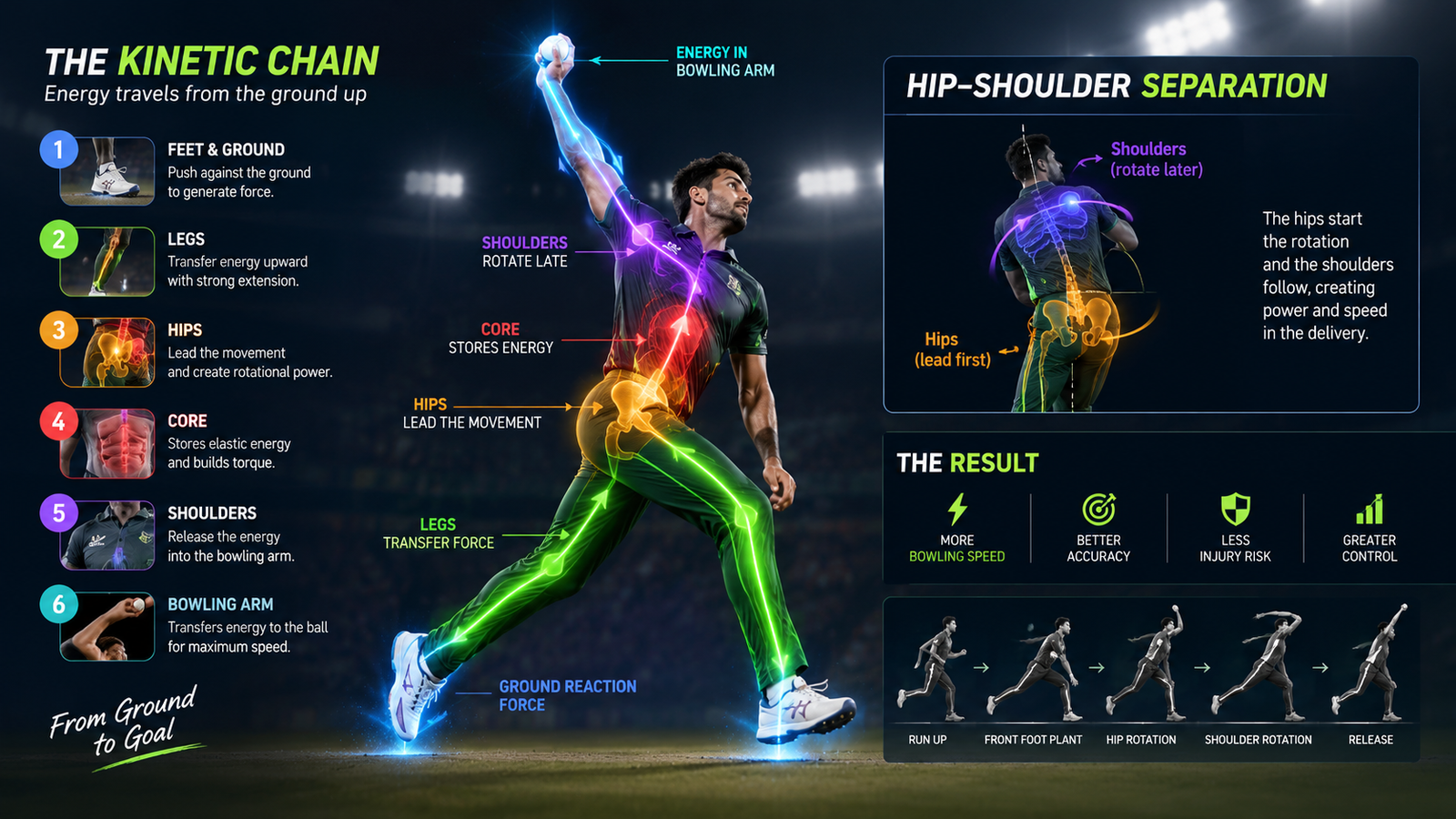
Pace comes from the ground up. The “kinetic chain” refers to how energy travels from your feet, through your legs, hips, torso, shoulder, arm, and finally into your fingers.
A critical biomechanical factor for fast bowlers is hip-shoulder separation:
-
As your back foot lands at the crease, your hips should drive forward first while your shoulders remain closed (facing sideways) for a fraction of a second.
-
This slight delay stretches the core muscles like a rubber band.
-
When your shoulders snap forward to catch up with your hips, that stored elastic energy explodes into the delivery arm, producing effortless speed.
3. Maintain a Strong Front Leg Brace
The front leg brace is one of the biggest secrets separating medium-pacers from express fast bowlers.
When your front foot lands on the pitch during the delivery stride, your front knee should remain straight and braced (firmly locked or only slightly bent).
Think of your front leg as a solid wall: when you run up fast and plant a rigid front leg, your lower body stops abruptly while your upper body whips over the top at high speed. If your front knee bends or collapses upon landing, all the forward momentum built during your run-up leaks away into the pitch.
4. Optimize the Non-Bowling Arm and Wrist Snap
Your non-bowling arm (the arm holding your front shoulder target) acts as a steering wheel and momentum generator.
-
Pull the Non-Bowling Arm Down Hard: Drive your non-bowling arm high toward the target, then pull it down forcefully past your hip as you deliver the ball. This downward pull accelerates the rotation of your bowling shoulder.
-
High Release Point: Keep your bowling arm close to your ear at release to maximize leverage and generate steep bounce along with speed.
-
Explosive Wrist Snap: At the exact moment of release, snap your wrist forward over the ball. A firm, upright seam position combined with a quick wrist snap adds extra miles per hour and sharp seam movement.
5. Strength and Conditioning for Fast Bowlers
You cannot bowl fast with a weak physical foundation. Fast bowlers undergo immense physical impact landing forces at the crease can reach up to 6 to 8 times a bowler’s body weight.
A complete bowling speed workout focuses on power, mobility, and core strength rather than bulk muscle:
Key Gym Exercises for Pace
-
Lower Body Explosiveness: Trap bar deadlifts, barbell squats, and lunges build the quad and glute strength needed to absorb landing forces and drive off the pitch.
-
Core and Anti-Rotation Stability: Planks, Russian twists, and cable woodchoppers stabilize your spine during hip-shoulder separation, translating rotational force into pace.
-
Upper Body Power: Medicine ball slams and landmine presses build explosive push-pull power in your chest, shoulders, and lats.
-
Plyometrics: Box jumps, bounding, and single-leg hops improve reactive strength in your tendons, allowing you to spring off the pitch faster.
6. Video Analysis and Technical Adjustments
It is difficult to judge your own bowling action based purely on feel. Modern fast bowling relies heavily on video analysis to spot biomechanical flaws.
Set up a high-frame-rate smartphone camera to record your bowling action from two angles: side-on and directly behind the bowler’s arm. Check for:
-
Is your front knee collapsing upon landing?
-
Are your hips and shoulders opening up simultaneously or creating separation?
-
Is your non-bowling arm pulling down past your hip or collapsing early?
Correcting one technical flaw at a time through slow-motion drills (such as walk-through bowling drills) builds muscle memory faster than trying to fix everything at once during a live match.
Common Fast Bowling Myths to Avoid
-
Myth 1: “Bulking up in the gym will make you bowl faster.” Adding heavy muscle mass without speed and mobility training makes your joints stiff, slowing down your arm speed.
-
Myth 2: “Just bowl harder with your arm.” Arm speed accounts for only a fraction of total pace. Ground reaction forces and core rotation generate the majority of speed.
-
Myth 3: “A longer run-up automatically equals more speed.” An overly long run-up simply tires you out. Your run-up should only be as long as necessary to reach optimal sprinting rhythm at the crease.






Leave feedback about this